Deep Conversations
Why We Need Deep Conversations?
Our government is quickly sinking into Authoritarianism. They boost hate, fear, lies and division to gain power. Authoritarians capitalize on poverty and rising inequality to scapegoat minorities, to offer simplistic solutions to complex problems and to undermine democratic institutions. The key to protecting Democracy is to foster deep conversations with our fellow citizens to establish personal connections, to build an opposition movement, and to create pro-Democracy social change. In our neighborhood groups, we can practice and support one another in having deep conversations.
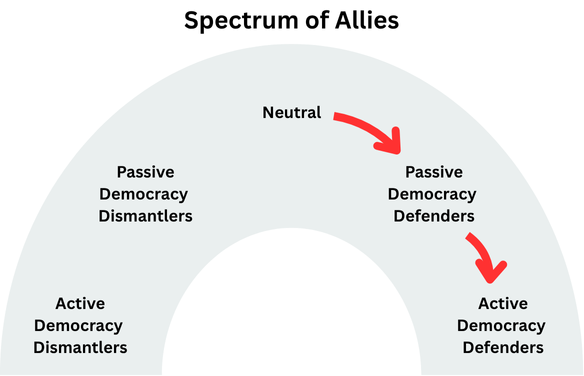
The COVID pandemic has led to insularity; thus, it is essential to develop new habits of initiating conversations with neighbors and strangers. Not with arguments and facts, but with deep conversations, we nudge those who have been passive defenders and those neutral toward Democracy to become active Democracy defenders.*
What are the Principles of Deep Conversations?
Empathic Listening: This is generous listening, holding assumptions and judgments lightly. Paraphrasing what someone has said and asking if you got it right helps foster trust.
Sharing Personal Stories: This fosters trust and a sense of kinship.
Open-Ended Questions: This invites deeper understanding of what matters to the other person. Asking the 5 Ws (Who, What, Where, When, Why) can reinforce active listening.
Focus on Values, Not Facts: This promotes understanding beyond a simplistic right and wrong.
Deep conversations can lead to solidarity, prompting us to consider what we can do together to address pressing issues.
Explore Deep Conversations in Your Neighborhood Group:
Encourage each other to talk to people using deep conversations.
Use a starter script to get your ‘feet wet’. ** Try another script for people you want engage.***
Form a buddy group to bounce ideas off of and discuss your experiences with deep conversations. Report back your experiences to your Neighborhood Group.
One idea, if you want to knock on doors in your neighborhood, is to tell people you want to organize an emergency preparedness session and would they be interested in attending.
Another idea, go to a public space as a neighborhood group with a large sign that says: "We think the Trump regime is harming many people. What do you think? What can we do? Talk to us." Then engage is some deep conversations with passersby.
You can’t influence someone’s views, if you don’t first convince them that you are open to questioning your own views and will treat them with respect.
When you have a disagreement, consider asking, “I am interested in what you’re saying. Can you tell me more about why you think that?”
*Nudge Passive Dismantlers & Those Neutral toward Democracy to become Democracy Defenders
-
You: Hi, how are you doing?
Other: Fine. How about you?
You: Well, I'm worried about what's coming out of DC. How about you?
Other: Yeah, me too.
You: Yeah my son/brother/friend who was a federal worker was fired from his job and he was really doing a great job. It has devastated him and I feel so bad for him.
Other: Oh that is really too bad.
You: Do you know anyone who has had a similar experience?
Other: ...................."
You: Tell me more about that.
Other:...........
You: Let me get this straight, (paraphrase). Is that right?
Other:.........
You: That must be really hard for you/him.
Other:......
You: What do you think we can do?
Other:............
You: I hear you. (Maybe we could do something in our neighborhood to......)
Other..........
-
You: I’m very concerned about the harms being caused by this Trump regime. Are you aware of anyone who has been harmed?
Other: ….
You: I'm worried about (pick one):
health researchers whose funding from NIH, CDC & EPA is threatened
people with disabilities whose Medicaid health care is threatened
farmers facing bankruptcy due tariffs causing loss of markets and due to cuts to federal purchases for USAID & food banks
parents with young children whose childcare has been cut
poor elders whose Social Security is threatened
poor people who face rising prices for food, healthcare and housing
How do you think we should deal with all these harms caused by this president?
Other: …
You: Many of our political leaders (Booker, Murphy, Raskin, Sanders, Warren, AOC …), and even conservative columnist David Brooks are calling for a national civic uprising, for people power to protect Democracy. How can we mobilize people for a citizen’s uprising?
Other: …
You: We need a broad-based uprising. We also need a new vision of the future, which appeals to all these constituents. We can talk with others about the need for this citizens uprising. We can join pro-Democracy groups like the Indivisible.org groups and we can work with those groups to help mobilize this citizens uprising. Communities Rising, Wallingford Indivisible, and Seattle Indivisible are some of the local pro-Democracy groups.
Other: …
You: Thanks for sharing your thoughts.