Book Clubs
Book clubs help us individually and collectively to learn how we can respond to the dangers of this fascist, militaristic oligarchy and to the polycrisis of climate change, ecosystem destruction, and breaching planetary boundaries. Here are four active groups you can join:
Third Act WA — Seattle Climate Conversations; book club in September: Climate Wayfinding.
350 Seattle — long-running club; recent pick: Polemic For Democracy.
Wallingford Indivisible— theme-based discussions (e.g., social revolutions, voting rights ….).
Communities Rising — studied Beautiful Trouble and Practical Radicals; new book in September.
Strategies to Defeat Fascism*
Movements succeed by deploying multiple strategies simultaneously and sequentially.
Personal Transformation - inner work (self-care, learning, skills, interdependence with nature), helping others (neighborhood connnections, emergency preparedness)
Base-Building / Unite Underdogs — deep relationship-based recruitment - empathic conversations, engage passive defenders of democracy to become active defenders.
Narrative Shift/ Story-Telling — win hearts & minds by offering a new, shared story; weaken pillars of support for overdogs; culture-jamming & pranktivism ("trillionaires for Trump").
Disruption— strict non-violent protests, strict avoidance of property destruction, strikes, boycotts with production or distribution chokepoints; use OODA Loop (Observation, Orientation, Decision, Action for tactical agility) .
A Positive Vision - economic democracy (wealth taxes, anti-monopolies), political reforms (address money in politics & voter suppression, abolish filibuster in Senate, Supreme Court reform), institutional transformation (universal basic services, de-militarization, support democratic allies & foreign aid / global health), address the polycrisis (climate, environment, pollution), prefigurative actions - live out alternative solutions.
Electoral Change — year-round organizing to win governing power.
Inside-Outside Campaigns — coordinate progressive leaders and grassroots initiatives.
Momentum Model / Movement Cycles— combine protest and narrative to capture upsurges and crises; given this moment in time, what should we be doing.
Collective Care — mutual aid and support networks that sustain movements, understand and protect minorities and the vulnerable.
Five Tests For Transformational Strategy
Vision - Do we maintain clear, aspirational goals, not just critique the status quo?
Conjuncture - Are we reading the current landscape accurately?
Division - Does this action divide & weaken overdog power structure?
Toolkit - Are we layering base-building, disruption & narrative structure?
Empathy - Are we telling a compelling story, rooted in shared values?
The Decentralized Leadership Network
Distributed leadership — harder to decapitate.
Autonomous local pods — act without central permission.
Shared political compass — unified anti-fascist, pro-democracy framework.
*Adapted from the book Practical Radicals, the website Beautiful Trouble, and the video Movement Ecology.
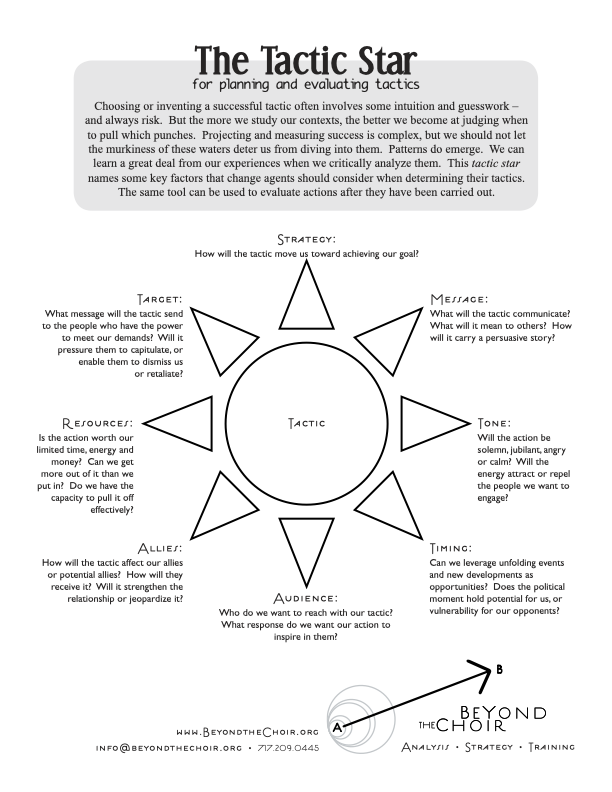
Beautiful Trouble Strategies. Effective protests convert attention (“noise”) into pressure (“leverage”) by pairing tactics with a clear strategy. The core moves are to map who really holds power (and the secondary targets who influence them), broaden support by shifting neutrals and passive allies toward active support, and win the narrative with agile, values-based messaging. Movements sustain impact by coordinating inside–outside efforts and escalating in planned steps—while staying alert to negotiations used as stalling tactics.
Tactical Discipline Protesting, Strict Non-Violence. Successful movements prioritize sustained participation, narrative clarity, and disciplined nonviolent tactics—not because anger is absent, but because strategic nonviolence protects legitimacy and widens support. Movements rarely win by matching state coercion; they win by exposing misuse of power in ways that invite more people in rather than pushing them away.
. Snider J, 2026
Chenoweth E, 2026.
Strategies for Practical Radicals. Successful movements pair disciplined, nonviolent tactics with clear power analysis, coalition-building, narrative strategy, and planned escalation—while avoiding dynamics (like property damage or reactive escalation) that erode public support and give opponents “law and order” framing advantages.
Create leverage against the real decision-makers—through power mapping (primary + secondary targets), shifting people along a spectrum of allies, and running agile, values-based messaging.
Unite marginalized groups, exploit divisions among power-holders, and build nuanced alliances. Power shows up in multiple forms (ideological, political, economic, coercive, solidarity, disruptive), and movements often combine several “strategy models” (base-building, disruption, narrative shift, electoral work, inside–outside, momentum, collective care).
A decentralized, directed network is more resilient than rigid hierarchies or purely leaderless movements—able to coordinate swarming action while resisting decapitation by repression.